
No two students are the same, so why do we teach them all the same way?
That question has been sitting at the heart of educational debate for decades. Traditional classrooms have long operated on a fundamental assumption: if there are 30 children in a room with one teacher and one curriculum, they will all move through the material together, at the same pace, in the same style, and arrive at the same destination by the same date.
That assumption is being challenged and the modern education system is responding. Personalised learning in education is no longer a niche idea reserved for progressive international schools. It is rapidly becoming the defining feature of how effective education looks in 2026.
What Is Personalised Learning in Education?
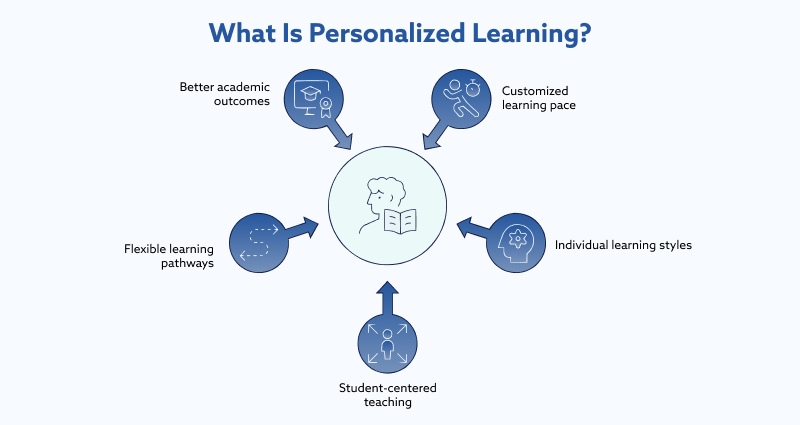
So, what is personalised learning in education? In the simplest terms, it is the shift from teaching to a class to teaching to a child. Rather than delivering the same lesson at the same pace to every student, personalised learning tailors the content, pace, and approach to each learner’s individual strengths, gaps, and interests.
For example, a student who grasps algebra instantly but struggles with essay structure does not need the same lesson plan as a student for whom it is the opposite. In a traditional classroom, one of them will be bored while the other is lost. In a personalised learning environment, both can move forward in the direction they actually need to go.
How the Modern Education System Is Embracing It?
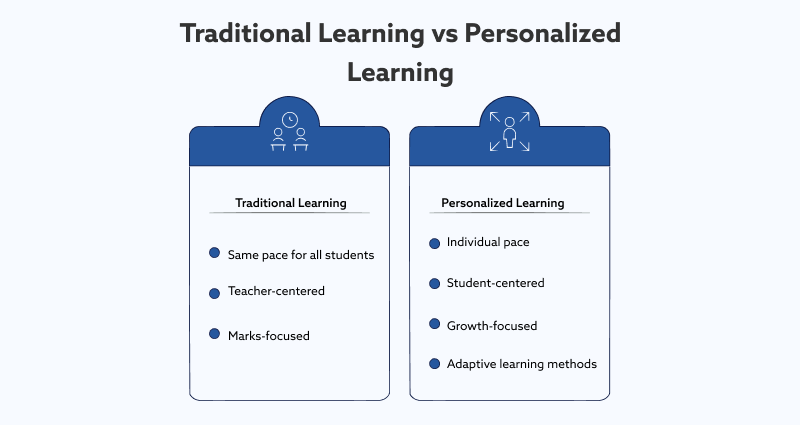
The modern education system is shifting on multiple fronts simultaneously and the pace of change is genuinely exciting. India’s National Education Policy 2020 represents a landmark shift at the policy level, moving away from rote learning and marks-only assessment towards competency-based, student-centred education.
Schools are increasingly moving towards Continuous and Comprehensive Evaluation (CCE), experiential and project-based learning modules, and flexible curriculum pathways that allow students to discover and develop their own strengths.
At the technology level, adaptive platforms are adjusting difficulty and content in real time based on individual student responses. Smart classrooms use data to flag when a student is struggling before an exam does. Research confirms that personalised learning paths, enabled by data analytics and AI, increase learner satisfaction by 40% and improve outcomes by an average of 20%.
Advantages of the Modern Education System
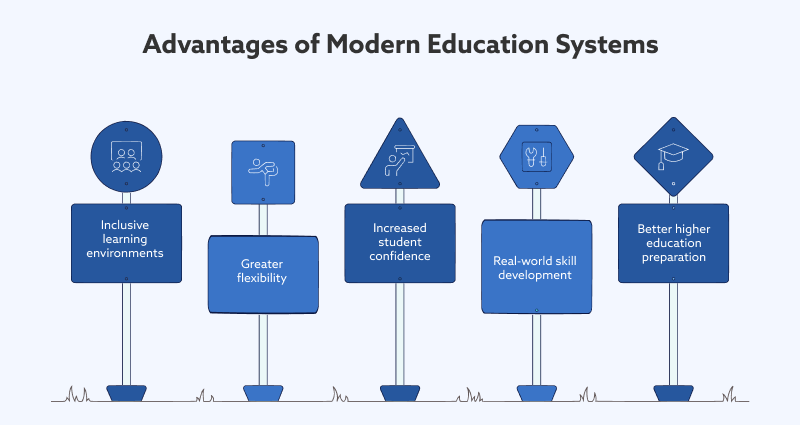
The advantages of modern education system approaches are measurable and meaningful. When students learn at their own pace, the fear of falling behind is significantly reduced. Confidence grows and curiosity is sustained.
For teachers, personalised frameworks provide data that allows them to direct attention precisely where it is needed. Some reports show score improvements of up to 30% over traditional classrooms when learning is genuinely adapted to the individual student.
Crucially, the advantages of the modern education system extend well beyond exam results. Students who learn in personalised environments show stronger critical thinking, better self-regulation, and more genuine readiness for the demands of higher education and professional life.
What Parents Should Look For?
When choosing a school, go beyond the brochure rankings. Ask: does this school know my child as an individual, or as a roll number? Look for small class sizes, varied assessment methods and co-curricular depth that allow teachers to genuinely engage with each student.
At The Camford International School, our “Inspired Learning” philosophy is built precisely around this shift. Small classes, a rich co-curricular programme, and a faculty committed to seeing each child as an individual; these are not extras. Our approach to personalised learning in education means your child is prepared not just for their next exam, but for a lifetime of confident and independent learning.
Give your child an education built around them; book a school visit at Camford today!